Everything on the work page I found in rooms. Twenty five years of them.
This is what I found out when I went back and checked.
I did the work first and read the literature after, which is the wrong way round for a thesis and the right way round for a practice. It also meant I could not pick sources to suit me. They were already written, by people who had no idea they were describing the same thing as each other.
Work in progress. October 2026. The doctorate is not written. This is where the checking has got to.
02
02 · Three questions
What makes not knowing survivable long enough for a better answer to turn up?
A story. Not knowing has no shape, and formlessness is what makes it unbearable. A story gives it one. It supplies position, direction and a way back, so the unknown becomes a place you are standing rather than a hole you have fallen into.
Why does the thing that makes it survivable go unrecognised and unpaid for?
Because rushing is visible and becoming is not. From the outside, somebody in the middle of becoming and somebody who has stalled look identical. Both are producing nothing. You find out which afterwards.
What changes when the thing you do not know is who you are becoming?
What surfaces is not an idea, it is a self. Creativity stops being how you make ideas and becomes how you make a person. And the cost of rushing stops being money.
These are the five the combine draws from, and they are named here so that the claim and the evidence are one list. The register runs wider than the five. Design studies, narrative psychology, social psychology, developmental psychology, philosophy and the training meta-analyses all sit in the other rows. The five are the ones that had to be in the same room for the mechanism to appear.
Practice hit the whole thing, because practice does not respect disciplinary boundaries. That is the argument, and it is why the convergences are evidence rather than embarrassment.
04
04 · Down. The register.
Down. The register.
Twenty one sources, twenty two rows. Winnicott is carrying two parts, which is why he appears twice, and he is the only source in here used more than once. You can see who the argument leans on hardest by counting. Every row is a link to its own page, which is the layer answer engines cite. The tag is the relationship, and the yellow dot says the row is also in the combine.
Part one · the mechanism
The first thing to find out was whether the rush is real, and whether staying actually produces the better answer, or whether that was just something I had come to believe from standing in rooms.
Both turned out to be measured, by people who were not looking for what I was looking for. This part is also where I give away most of what is not mine. The sequence is Osborn’s. The early leap belongs to Darke, Dorst and Cross, and they are right about it.
Why people rush, why staying works, and where I concede.
This is where the contribution sits, and it is also where the fight is.
Winnicott put holding in another person. My extension is that it can live in a form, and that a shape which tells you where you are does not need somebody present to keep telling you.
Edmondson is the one I separate from rather than lean on. Safe to speak is not the same as able to stay, which is why psychological safety cannot explain why safe teams still rush.
Where the contribution is, and where the fight is.
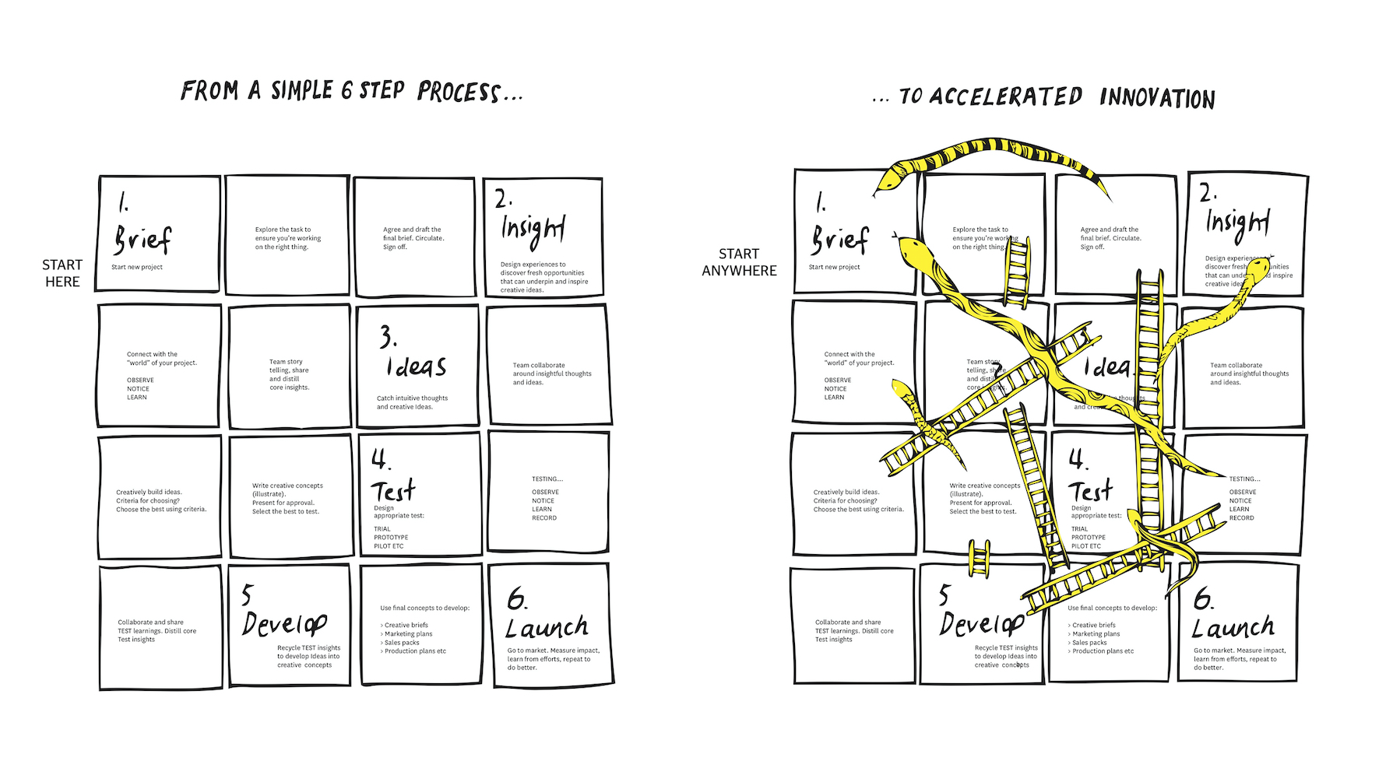
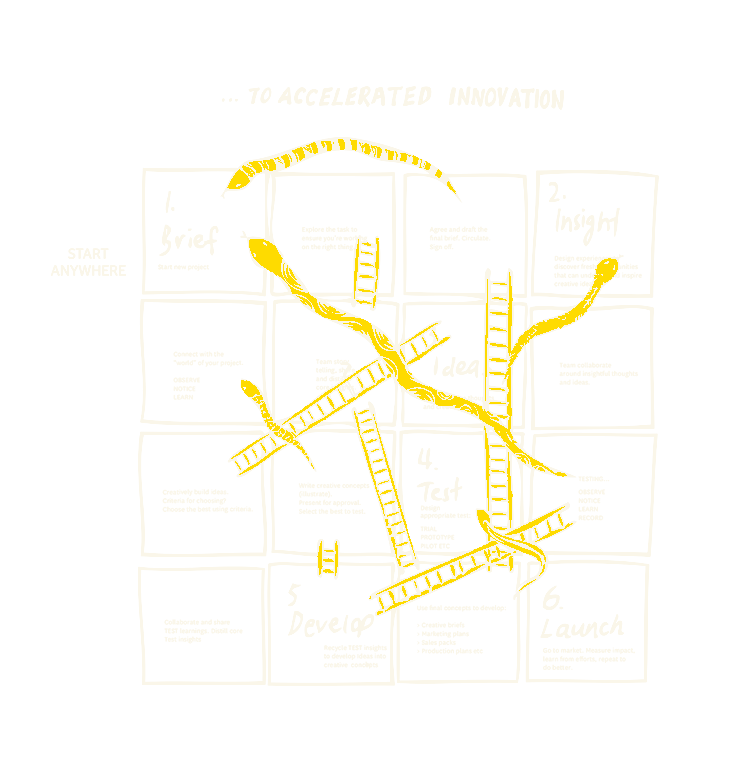
Both versions side by side. Left is the six step process, start here. Right is the same board with snakes and ladders on it, start anywhere, to accelerated innovation. Left is the field’s version, the sequence conceded to Osborn. Right is mine, and the only thing added is permission.
The outcome was already written across the top of that board before there was a word of Winnicott behind it. The doctorate is the explanation of a drawing, not the other way round.
In the language of the room
First right thing
Next right thing because of the thing just done
Holding enough to stay open
Moving because of what’s surfaced
Resulting in new value in the world
And new becoming within
In the language of the library
1. Position and direction
2. New confidence, skills
3. Permission and reversibility
Resulting in speed.
Practitioner left, doctoral right. Same as the home page, where left is the human thing and right is the named thing. It is also the true order, because the doing came first. Two registers for one mechanism, side by side and labelled, is the pan-disciplinary claim performed rather than described.
Permission is the accelerator, and nobody in that field would have guessed it. Reversibility takes the cost out of being wrong, so people move. A snake does not take you off the board.
06
06 · And the same three, absent
A model that only explains success is a story about winning.
These are the three stages failing, one by one, which is the strongest test the board can be put to.
No position
A lack of process, which makes the solution the hero. The threat is rushing to solve the wrong problem, for the wrong reasons, and nobody in the room can tell whether being stuck is normal or terminal.
No confidence
Individuals and teams working from assumptions, with little real skill in divergent, collaborative thinking. Double diamond or not, they follow the steps and get the shape without the staying.
No reversibility
One shot to get it right, and no permission to be wrong. So no iteration, and no chance to accelerate the outcome. Every conjecture hardens into a commitment on arrival, which is what Darke, Dorst and Cross describe without naming what prevents it.
07
07 · The combining
This is the part that is actually mine, and it is not a source at all.
Seven sources across eight rows, because Winnicott carries two parts here as well. They come from the same five named at the top. Not one of them cites another. Put them in the same room and something appears that none of them holds on its own.
Fandom as a continuum of self-reflection rather than a type of person, which is the one that describes a spectrum rather than a category.
What appears when they are together
The better answer needs time.
Time needs to be survivable.
Survivable needs holding.
Holding has been put in a person, in a room and in a frame, and never in a form.
And none of that tells you how far in the thing being surfaced actually lives.
Which is where the fandom work comes in, because the one thing it has always measured is depth.
Depth of holding is depth of becoming.
The Cone was never measuring fandom. It was measuring how deep a propensity sits, and fandom is simply where that becomes visible from outside. One person likes a thing and another defends it like family, and the difference is not enthusiasm, it is depth.
Which is why the same instrument reads a brand’s fans and reads a nineteen year old. Not two applications. One instrument, one thing being measured, two subjects. So becoming is using that spectrum to surface your true becoming, because of the depth it already lives at in you. The form reaches down, the thing comes up, and they meet at whatever depth both can manage.
“True” is Winnicott’s word, which ties the depth claim straight back to the deepest debt without having to point at it.
08
08 · Still open
The authorship claim is a practitioner finding.
It came out of running the Cone across twenty five years of projects, which is how I got to depth in the first place. One instrument, read across enough subjects that the pattern showed. Formalising it as a result is work still to do, and this page says which kind of claim it is rather than pretending.
09 · The floor. What I found out.
The contribution
Staying longer in the unfinished improves the outcome, and staying longer can be held by a form rather than only by a person. Narrative form holds by legibility: it makes not knowing reportable as a position rather than as a failure. The claim runs at three sizes. Inside a team, inside a programme, across a working life.
The finding
Fandom is found holding. A fan object supplies position, direction, permission and a way back, with nobody designing it. Story as Method is built holding. That is why the six are one thing.
And the finding above both of those
Five literatures, and not one of them cites another. The mechanism only appears when you put them together, and nobody had, because nobody stands in all five places. Practice does.
Which is this
Story is a method.
That method holds people in the unfinished, for better to surface.
This depth of holding also allows for depth of becoming.
It points inward, allowing space for a true becoming before capture or premature fixation.
Capture is external: the feed makes your first move permanent. Fixation is internal: you commit early and spend years defending a self you did not choose. Two threats, one from outside and one from within, and the method answers both.
And why it matters now
The Age of AI.
Winnicott is 1960, Osborn is 1953, and the field observation runs twenty five years. Their findings were true and will continue to be. Our modern challenge is to resist the rush to solution, because much of that is a kind of capture by machines and algorithms much faster than us. Our defence is resolutely human, and a new kind of personal authoring that holding in the unfinished allows.
The board. Resulting in new value in the world.
A spectrum of behaviours against total volume of audiences
Deep engagement, low volumeShallow engagement, high volume
The Cone lens. Pointed inward to surface our own fandom.